100, Mohangirikrupa estate, Deluxe Wafer Lane, Nr Jupiter Cross Road, GIDC Makarpura, Vadodara


Bearing manufacturing requires precision, consistency, and controlled production processes to ensure reliable performance in demanding…
- Automation Tips
- 11 minute read
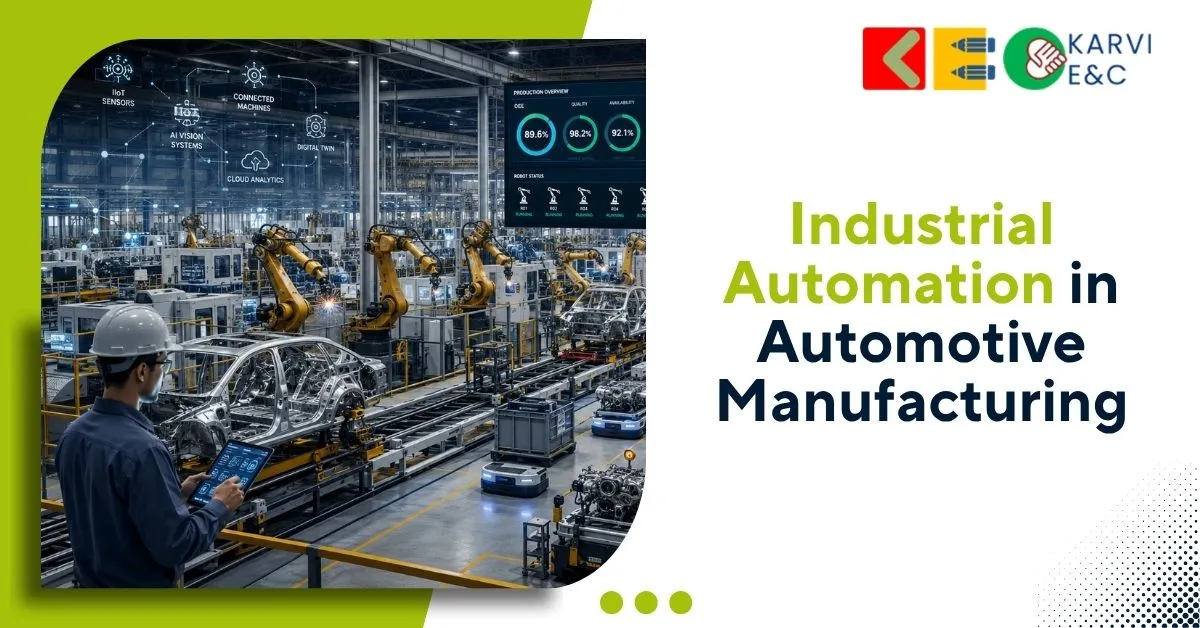
The automotive industry has long been recognized as one of the earliest adopters of advanced manufacturing technologies. As customer expectations continue to evolve and vehicle designs become increasingly complex, manufacturers must deliver high-quality vehicles while maintaining speed, precision, and cost efficiency. Traditional production methods alone are no longer sufficient to meet these growing demands.
This is where Industrial Automation has become a game-changer for modern automotive manufacturing. By integrating robotics, intelligent control systems, AI-powered inspection, and connected production technologies, manufacturers can improve productivity, reduce errors, and achieve consistent quality across every stage of production.
Whether producing conventional vehicles, electric vehicles (EVs), or hybrid models, automotive companies are investing in automation to build smarter factories that can quickly adapt to changing market demands. As a result, Industrial Automation is no longer simply about replacing manual work it is about creating efficient, flexible, and future-ready manufacturing operations.
Why Automotive Manufacturers Are Embracing Automation?
Manufacturing a vehicle involves assembling thousands of individual components with exceptional accuracy. Every process, from welding and machining to painting and final assembly, must meet strict quality standards to ensure vehicle safety and performance. Even a small variation can lead to production delays, increased costs, or product defects.
To overcome these challenges, manufacturers are moving toward intelligent production systems that improve consistency and operational efficiency. Industrial Automation enables factories to integrate robotics, programmable logic controllers (PLCs), sensors, and digital monitoring systems into a unified manufacturing environment. These technologies automate repetitive and precision-based tasks while allowing engineers and operators to focus on process optimization and innovation.
The growing demand for customized vehicles, shorter production cycles, and electric mobility has further accelerated the adoption of automation. Modern automotive plants require flexible manufacturing systems that can quickly accommodate design changes without compromising productivity or product quality.
Key Applications of Industrial Automation in Automotive Manufacturing
Modern automotive plants rely on automation throughout the production process to achieve greater efficiency and precision. Industrial Automation connects advanced machines, intelligent software, and control systems to streamline manufacturing operations while maintaining high-quality standards.
| Manufacturing Process | Automation Solution | Key Benefits |
| Body Welding | Industrial Robotic Arms | Precise and consistent weld quality |
| Vehicle Assembly | Automated Assembly Systems | Faster production with fewer errors |
| Material Handling | AGVs & AMRs | Smooth movement of components |
| CNC Machining | Automated CNC Machines | High machining accuracy |
| Paint Shop | Robotic Painting Systems | Uniform coating and reduced waste |
| Quality Inspection | AI & Machine Vision | Early defect detection |
| Packaging | Automated Conveyors | Improved workflow efficiency |
By integrating these technologies into a connected production environment, manufacturers improve operational efficiency while maintaining consistency across every production stage.
Robotic Automation Enhances Production Precision
Industrial robots have become one of the most valuable assets in modern automotive manufacturing. They perform repetitive tasks with exceptional speed and precision while maintaining consistent quality throughout long production cycles. From welding body panels to assembling complex components, robotic systems significantly improve manufacturing accuracy.
Rather than operating independently, Industrial Automation connects robotic arms with PLCs, sensors, machine vision systems, and centralized production controls. This integration ensures that every robot performs its task in perfect coordination with other machines on the assembly line, reducing process variation and improving production flow.
Robotic automation is commonly used for:
- Spot welding
- Arc welding
- Body assembly
- Screw fastening
- Windshield installation
- Wheel mounting
- Adhesive application
- Battery pack assembly
- Component handling
Collaborative robots (cobots) are also becoming increasingly common in automotive plants. Working safely alongside human operators, cobots handle repetitive and physically demanding tasks while employees focus on inspection, programming, and quality assurance. This balanced approach improves productivity while creating a safer working environment.
Smart Material Handling Improves Production Flow
A continuous supply of components is essential for maintaining production efficiency in automotive manufacturing. Delays in transporting engines, batteries, body panels, or other parts can interrupt assembly lines and increase operational costs. Efficient material handling therefore plays a crucial role in keeping production schedules on track.
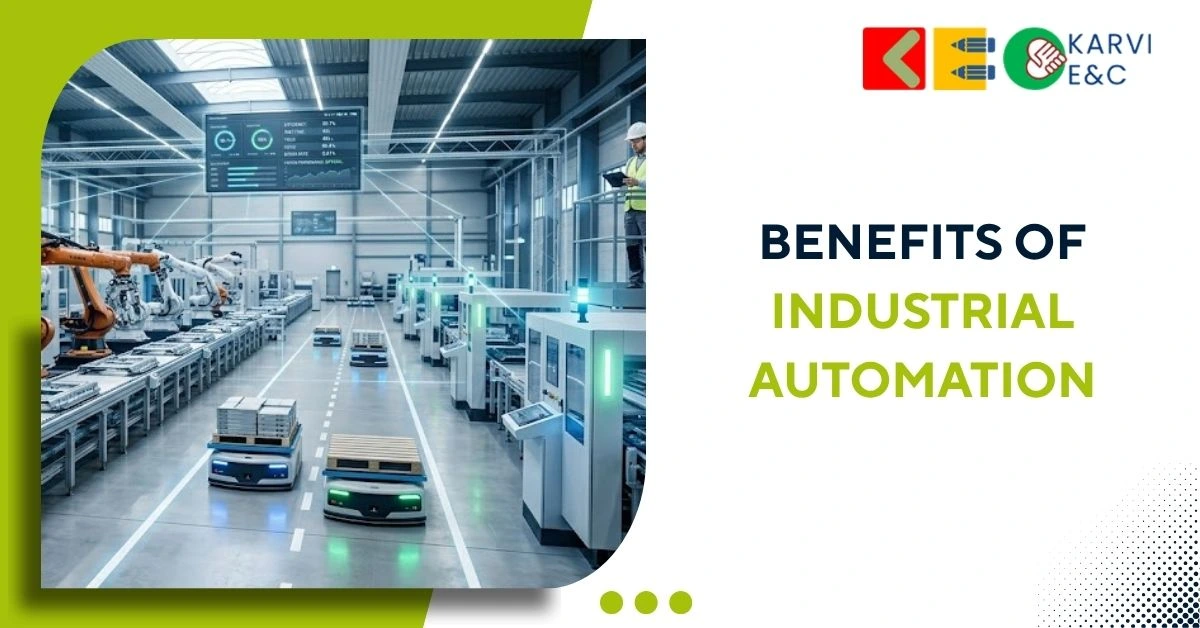
To address these challenges, Industrial Automation integrates Automated Guided Vehicles (AGVs), Autonomous Mobile Robots (AMRs), intelligent conveyor systems, and automated storage solutions into the manufacturing process. These systems transport materials accurately between workstations while synchronizing inventory movement with production requirements.
Automated material handling offers several advantages:
- Reduced production bottlenecks
- Improved inventory management
- Faster movement of components
- Lower manual handling requirements
- Better production scheduling
- Enhanced workplace safety
By ensuring that components reach the right workstation at the right time, manufacturers achieve smoother production flow and higher operational efficiency.
AI and Machine Vision Improve Quality Control
Maintaining consistent quality is one of the biggest priorities in automotive manufacturing. Every vehicle component must meet strict engineering specifications to ensure safety, durability, and customer satisfaction. Manual inspections often struggle to detect microscopic defects, particularly during high-volume production.
This is where Industrial Automation strengthens quality control by integrating AI-powered machine vision systems throughout the production line. High-resolution cameras, intelligent software, and advanced algorithms continuously inspect components with greater speed and accuracy than conventional inspection methods.
Machine vision systems can identify:
- Surface defects
- Paint imperfections
- Incorrect assembly
- Missing components
- Weld inconsistencies
- Dimensional variations
- Alignment errors
The data collected during automated inspections also helps manufacturers identify recurring quality issues and optimize production processes. By detecting defects early, manufacturers reduce rework, minimize waste, and improve overall product reliability.
Industry 4.0 Is Creating Smart Automotive Factories
The automotive industry is rapidly transitioning from conventional manufacturing facilities to connected smart factories. Industry 4.0 combines IoT devices, cloud computing, artificial intelligence, and real-time analytics to create intelligent production environments capable of responding quickly to changing manufacturing conditions.
At the center of this transformation is Industrial Automation, which connects machines, sensors, PLCs, SCADA systems, Manufacturing Execution Systems (MES), and Digital Twin technologies into a single integrated ecosystem. Instead of operating as isolated machines, production equipment communicates continuously to improve coordination and operational visibility.
Smart factories enable manufacturers to:
- Monitor production in real time
- Optimize machine performance
- Track energy consumption
- Improve production planning
- Identify bottlenecks quickly
- Reduce unexpected downtime
These capabilities allow manufacturers to make data-driven decisions while continuously improving production efficiency and product quality.
Looking to implement Industrial Automation in your automotive manufacturing processes? Contact Us for customized automation solutions.
Predictive Maintenance Reduces Equipment Downtime
Unexpected equipment failures can significantly impact automotive production by causing delays, increasing maintenance costs, and reducing productivity. Traditional maintenance schedules often rely on fixed service intervals, which may result in unnecessary maintenance or unexpected machine failures.
Modern manufacturers are replacing these traditional approaches with predictive maintenance strategies. Industrial Automation continuously collects operational data from production equipment through sensors that monitor temperature, vibration, pressure, motor performance, lubrication, and machine cycles.
Artificial intelligence analyzes this information to detect early signs of equipment wear before failures occur. Maintenance teams can then schedule repairs during planned downtime rather than responding to emergency breakdowns.
Predictive maintenance helps manufacturers:
- Improve equipment reliability
- Reduce maintenance costs
- Extend machine lifespan
- Increase Overall Equipment Effectiveness (OEE)
- Minimize production interruptions
As automotive manufacturing becomes increasingly automated, predictive maintenance plays an essential role in ensuring uninterrupted production.
Industrial Automation Supports Electric Vehicle Manufacturing
The rapid growth of electric vehicles has introduced new production requirements that demand greater precision and consistency than conventional vehicle manufacturing. Battery cells, battery packs, electric drivetrains, and thermal management systems require highly controlled manufacturing processes to ensure both performance and safety.
To meet these demands, Industrial Automation integrates robotic assembly systems, laser welding, automated battery handling, intelligent testing equipment, and machine vision inspection into EV production lines. These technologies improve manufacturing accuracy while maintaining complete traceability throughout the production process.
Automation also supports:
- Battery cell handling
- Battery pack assembly
- Precision adhesive dispensing
- High-voltage component testing
- Automated quality inspection
- Laser welding operations
As global demand for electric vehicles continues to grow, automation enables manufacturers to increase production capacity while maintaining consistent product quality and operational efficiency.
Benefits of Industrial Automation for Automotive Manufacturers
Automotive manufacturers operate in a highly competitive environment where production speed, product quality, and operational efficiency directly influence business success. As production requirements become more demanding, manufacturers need technologies that improve performance without compromising consistency. Industrial Automation provides a practical solution by connecting intelligent machines, control systems, and real-time monitoring technologies to optimize every stage of manufacturing.
Some of the key benefits include:
- Increased production efficiency
- Improved product quality
- Reduced manufacturing defects
- Faster production cycles
- Lower operational costs
- Better workplace safety
- Reduced material waste
- Higher equipment utilization
- Improved process consistency
- Greater manufacturing flexibility
- Enhanced production traceability
- Real-time production monitoring
Beyond these measurable improvements, Industrial Automation enables manufacturers to respond quickly to changing customer demands and new vehicle technologies. Whether introducing a new vehicle model or expanding production capacity, automated systems provide the flexibility needed to maintain productivity while ensuring consistent manufacturing standards.
Challenges in Implementing Industrial Automation
Although automation offers significant advantages, successful implementation requires careful planning and engineering expertise. Every automotive manufacturing facility has unique production requirements, existing equipment, and operational goals that must be considered before introducing automation technologies.
One of the primary challenges is integrating new automation systems with legacy machinery without disrupting ongoing production. Industrial Automation projects often require detailed process analysis, customized system design, and phased implementation to ensure smooth integration and minimal downtime.
Manufacturers may also face challenges such as:
- High initial investment
- Workforce training and skill development
- Legacy equipment compatibility
- Cybersecurity risks
- Production transition planning
- System scalability
- Maintenance and technical support
Partnering with experienced automation experts helps manufacturers overcome these challenges by developing customized solutions that align with production objectives while maximizing long-term return on investment.
The Future of Industrial Automation in Automotive Manufacturing
The automotive industry continues to evolve with rapid advancements in artificial intelligence, connected manufacturing, and smart production technologies. Manufacturers are increasingly investing in intelligent systems that can improve decision-making, optimize production processes, and support the growing demand for electric and autonomous vehicles.
As these technologies continue to mature, Industrial Automation will play an even greater role in creating highly connected manufacturing environments where machines communicate, analyze data, and respond to changing production conditions with minimal human intervention.
Future developments are expected to include:
- AI-driven autonomous production systems
- Greater adoption of collaborative robots
- Digital Twin-enabled production optimization
- Advanced predictive analytics
- Self-learning manufacturing systems
- Expanded use of Autonomous Mobile Robots (AMRs)
- Increased human-machine collaboration
- Sustainable and energy-efficient manufacturing
Manufacturers that invest in automation today will be better positioned to improve operational efficiency, maintain consistent product quality, and adapt to future technological advancements. As automotive production continues to transform, Industrial Automation will remain one of the most important drivers of innovation and manufacturing excellence.
Frequently Asked Questions
Industrial Automation refers to the use of robotics, intelligent control systems, sensors, AI, and digital technologies to automate manufacturing processes, improve production efficiency, and maintain consistent quality across automotive production.
Industrial Automation improves automotive manufacturing by increasing production speed, reducing manual errors, enhancing quality control, optimizing material handling, and enabling real-time production monitoring for better operational performance.
Predictive maintenance helps manufacturers identify equipment issues before failures occur. Using Industrial Automation, sensors and AI continuously monitor machine performance, reducing downtime, maintenance costs, and unexpected production interruptions.
Industrial Automation supports electric vehicle production by automating battery assembly, robotic welding, quality inspection, component handling, and testing processes, ensuring greater precision, safety, and production efficiency.
Karvi Engineering & Consultancy provides customized Industrial Automation solutions, including automation system integration, smart manufacturing solutions, process optimization, and engineering support to help automotive manufacturers improve productivity, quality, and long-term operational performance.
Conclusion
The automotive industry is undergoing a significant transformation driven by technological innovation, changing consumer demands, and the rapid adoption of electric mobility. To remain competitive, manufacturers must build production systems that deliver exceptional quality, operational efficiency, and manufacturing flexibility.
By integrating robotics, AI, machine vision, smart material handling, and connected manufacturing technologies, Industrial Automation enables automotive manufacturers to streamline production, reduce operational costs, improve product consistency, and respond quickly to evolving market requirements.
As the industry moves toward smarter factories and digital manufacturing, investing in Industrial Automation is no longer just about improving production—it’s about creating resilient, future-ready manufacturing operations. With the right automation strategy and engineering expertise, automotive manufacturers can achieve sustainable growth while maintaining the highest standards of quality, productivity, and innovation.
Automotive IndustryAutomotive ManufacturingAutomotive ProductionFactory AutomationManufacturing Automation
Related Posts
Industries today operate in an increasingly competitive environment where efficiency, speed, and adaptability determine long-term…
The manufacturing and industrial sectors are rapidly evolving with the adoption of advanced technologies that…