100, Mohangirikrupa estate, Deluxe Wafer Lane, Nr Jupiter Cross Road, GIDC Makarpura, Vadodara



Manufacturing efficiency depends on more than increasing machine speed or adding automation. Factories also need…
- Automation Tips
- 5 minute read
Lean manufacturing is about removing activities that do not add value. Excess movement, waiting, manual material handling, and unnecessary energy consumption can all slow production and increase operational costs. While digital automation is often seen as the answer, not every manufacturing challenge requires robots, motors, or complex control systems. Karakuri Systems offer a simpler approach. By using mechanical principles such as gravity, springs, counterweights, and levers, they support Lean Manufacturing by improving material flow with minimal external energy.
What Makes Karakuri Different from Conventional Automation?
Conventional automation often relies on motors, sensors, PLCs, and electrical controls. Karakuri systems use mechanical energy and motion instead. A carefully designed mechanism can move, position, or present materials based on the movement already occurring within the production process.
This makes Karakuri Lean Manufacturing particularly useful where the objective is to solve a simple material handling problem without adding unnecessary complexity. The focus is not on replacing every manual activity but on finding practical ways to eliminate waste.
| Conventional Automation | Karakuri Systems |
| Requires electrical power | Uses mechanical principles |
| May involve complex controls | Simple mechanical mechanisms |
| Higher implementation complexity | Practical and application-specific |
| Suitable for complex tasks | Ideal for repetitive material movement |
How Karakuri Supports Lean Manufacturing Principles?
A core objective of Lean Manufacturing is improving flow while reducing waste. Karakuri systems directly support this by addressing unnecessary motion and inefficient material movement at the shop-floor level.
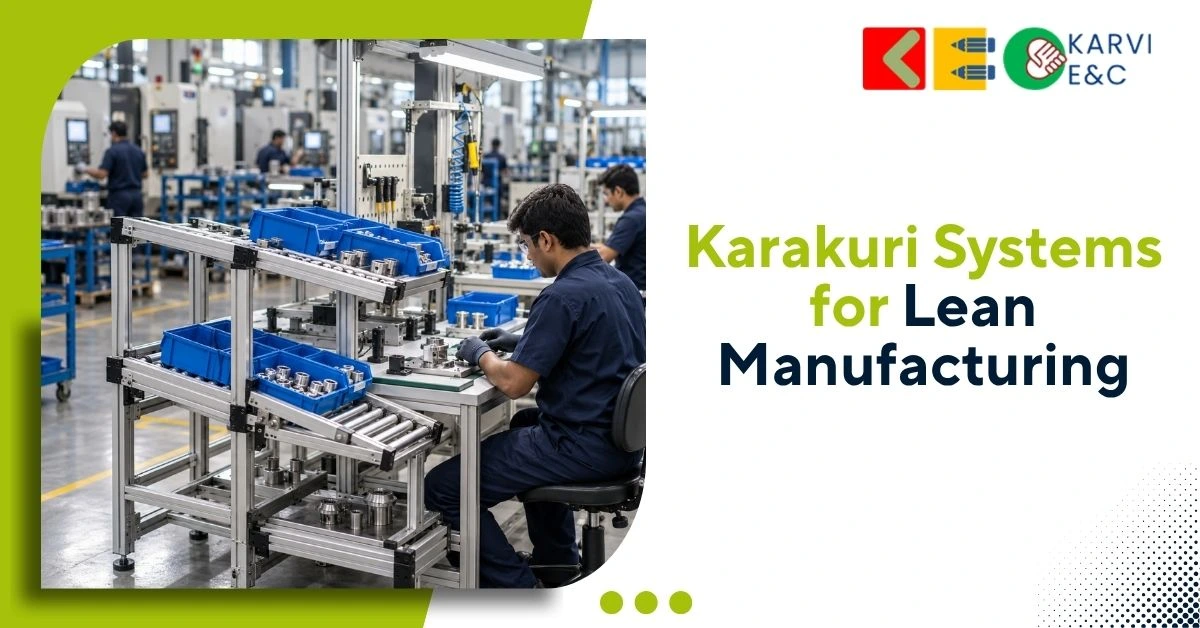
For example, components can be automatically presented to an operator after the previous part is removed, or containers can move through a workstation using gravity-based mechanisms. These small improvements can reduce repeated reaching, lifting, walking, and waiting.
The result is a more organized process where material movement supports the operator rather than becoming an additional task.
Reducing Manual Handling and Unnecessary Motion
Manual material handling is common in manufacturing, but repeated movement can create inefficiencies and operator fatigue. Moving bins, repositioning components, or repeatedly reaching for materials may seem like minor activities individually, yet they accumulate over an entire shift.
Karakuri systems can support manufacturing productivity by simplifying these movements. Gravity-fed racks, return mechanisms, and mechanical transfer systems can move materials between stages without requiring continuous manual effort.
This approach supports waste reduction in manufacturing while improving ergonomics and maintaining a smoother production rhythm.
Looking to improve material flow with practical Lean Manufacturing solutions? Contact Us to explore customized Karakuri systems.
Improving Production Flow Without Complex Automation
Not every process needs a fully automated solution. Sometimes, the most effective improvement comes from simplifying how materials move through the production line. Lean Manufacturing encourages manufacturers to examine the process before adding technology. Karakuri follows this principle by using simple mechanisms designed around the actual workflow.
These systems can support:
- Material presentation at workstations
- Component transfer between operations
- Empty container return
- Gravity-based movement
- Ergonomic material handling
- Low-cost automation initiatives
By improving individual movements, manufacturers can create better production flow optimization without significantly increasing system complexity.
Where Karakuri Systems Work Best?
Karakuri systems are particularly effective for repetitive, predictable material handling tasks. Assembly lines, manual workstations, machine loading areas, and intralogistics processes can benefit from mechanical solutions designed around specific movements.
They can also complement other automation technologies. Instead of viewing Karakuri as an alternative to all industrial automation, manufacturers can use it where a simple mechanical solution provides better value.
Why Simple Mechanical Solutions Deliver Long-Term Value?
The strength of Karakuri lies in its simplicity. Fewer electrical components and control systems can reduce maintenance requirements while supporting energy-efficient operations. More importantly, each system is designed to solve a specific operational problem.
For manufacturers pursuing Lean Manufacturing, Karakuri demonstrates that productivity improvements do not always require sophisticated technology. Sometimes, understanding the process and eliminating unnecessary motion is enough to create meaningful improvement.
Frequently Asked Questions
Karakuri uses mechanical principles such as gravity, springs, and counterweights to automate material movement without complex electrical systems.
They reduce unnecessary walking, lifting, waiting, and repetitive material handling, helping improve workflow efficiency.
Yes. Many Karakuri mechanisms operate using gravity and stored mechanical energy, reducing dependence on external power.
Yes. Karakuri systems can be designed around specific material movement, workstation layouts, component sizes, and production requirements.
Karakuri systems are commonly used in assembly lines, workstations, machine loading areas, and material handling processes with repetitive movement.
Conclusion
Karakuri systems bring a practical perspective to Lean Manufacturing by improving material flow through simple mechanical engineering. By reducing unnecessary motion, manual handling, and process delays, they help manufacturers build more efficient and organized production environments.
The key is not automation for its own sake, but choosing the simplest solution that effectively improves the process.
5s For Lean Manufacturing5s in Lean ManufacturingDefinition of Lean ManufacturingKarakuri Lean ManufacturingLean Manufacturing Methods
Related Posts

Choosing an automation partner is an important decision for manufacturers planning to improve productivity, quality,…
Bearing manufacturing requires precision, consistency, and controlled production processes to ensure reliable performance in demanding…