100, Mohangirikrupa estate, Deluxe Wafer Lane, Nr Jupiter Cross Road, GIDC Makarpura, Vadodara



Manufacturing companies are constantly looking for ways to control operating costs without compromising productivity or…
- Productivity Tips
- 5 minute read
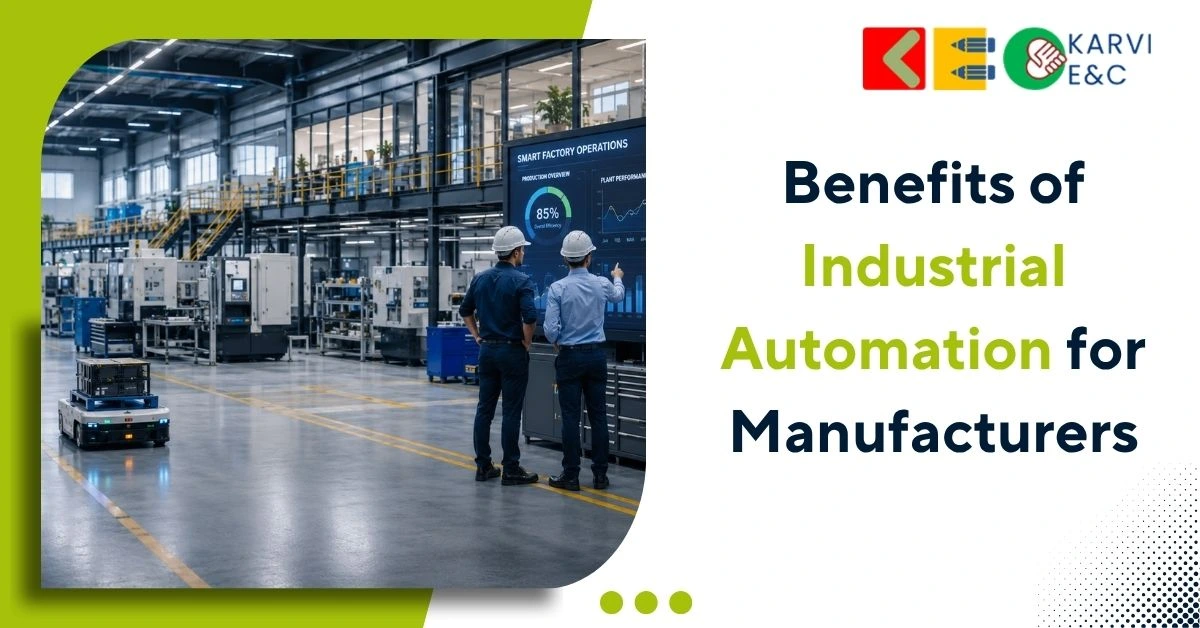
Manufacturing industries are under constant pressure to improve productivity, maintain product quality, reduce operational costs, and meet growing customer demands. Traditional production methods often struggle to keep pace with increasing requirements for speed, consistency, and efficiency.
To address these challenges, many manufacturers are adopting Industrial Automation to streamline operations and improve overall manufacturing performance. By integrating automated systems into production environments, organizations can reduce manual intervention, enhance process control, and create more efficient manufacturing workflows.
As manufacturing continues to evolve, automation has become a key driver of operational excellence and long-term competitiveness.
Understanding Industrial Automation in Manufacturing
Modern manufacturing environments require systems capable of delivering consistent results while maintaining efficiency across production processes.
Industrial Automation refers to the use of automated technologies, control systems, and intelligent equipment to perform manufacturing operations with minimal human intervention. These systems help manufacturers improve productivity, increase accuracy, and maintain process consistency.
Automation technologies can be applied across various production activities, including:
- Assembly operations
- Material handling
- Inspection processes
- Packaging systems
- Production monitoring
- Quality control
By automating repetitive and time-consuming tasks, manufacturers can achieve greater operational efficiency while reducing dependency on manual processes.
Improved Productivity and Operational Efficiency
One of the most significant benefits of Industrial Automation is improved productivity.
Automated systems operate with greater consistency and can perform tasks continuously without the limitations associated with manual operations. This enables manufacturers to increase production output while maintaining stable performance levels.
Productivity improvements often result from:
- Faster production cycles
- Reduced process delays
- Improved workflow efficiency
- Better resource utilization
- Reduced manual intervention
- Continuous production capability
As production systems become more streamlined, manufacturers can achieve higher throughput and stronger operational performance.
Enhanced Product Quality and Consistency
Maintaining consistent product quality is critical in modern manufacturing.
Manual processes can introduce variations that affect product accuracy and performance. Through Industrial Automation, manufacturers can standardize operations and reduce process variability.
Automation supports quality improvement by:
- Improving process repeatability
- Reducing human error
- Enhancing inspection accuracy
- Supporting real-time monitoring
- Maintaining production standards
Consistent manufacturing processes help organizations reduce defects, minimize rework, and improve customer satisfaction.
Key Benefits of Industrial Automation
| Manufacturing Challenge | Benefit of Industrial Automation |
| Manual process dependency | Improved operational efficiency |
| Production delays | Faster production cycles |
| Quality inconsistencies | Better process control |
| High labor-intensive operations | Reduced manual intervention |
| Process variability | Improved repeatability |
| Limited production capacity | Increased throughput |
These improvements help manufacturers create more reliable and scalable production environments.
Better Workplace Safety
Manufacturing operations often involve repetitive, physically demanding, or potentially hazardous tasks.
By implementing Industrial Automation, organizations can reduce employee exposure to high-risk activities while improving workplace safety.
Automation contributes to safer operations through:
- Reduced manual handling
- Lower exposure to hazardous environments
- Improved process control
- Safer material movement
- Reduced operator fatigue
A safer workplace not only protects employees but also supports stable and uninterrupted production.
Looking to implement Industrial Automation in your manufacturing processes? Contact us today for expert guidance and customized automation solutions.
Data-Driven Decision Making
Manufacturing success increasingly depends on accurate operational data and timely decision-making.
Modern Industrial Automation systems provide real-time visibility into production performance, machine utilization, and workflow efficiency.
This enables manufacturers to:
- Monitor production activities
- Identify bottlenecks quickly
- Improve resource allocation
- Optimize process performance
- Support continuous improvement initiatives
Access to accurate operational data allows organizations to make informed decisions that improve manufacturing outcomes.
Supporting Future-Ready Manufacturing
Manufacturing industries continue to evolve with increasing demands for flexibility, scalability, and operational efficiency.
By adopting Industrial Automation, manufacturers can build production systems that are better prepared to adapt to changing market requirements and technological advancements.
Automation supports future-ready manufacturing by enabling:
- Scalable production operations
- Improved operational agility
- Better process integration
- Enhanced manufacturing visibility
- Long-term productivity improvement
Organizations that invest in automation are better positioned to remain competitive in rapidly changing industrial environments.
Frequently Asked Questions
Industrial Automation involves using automated technologies and control systems to improve manufacturing efficiency, productivity, and process consistency.
Automation reduces manual intervention, improves workflow efficiency, minimizes delays, and supports continuous production operations.
Yes. Automation improves repeatability, reduces human error, and helps maintain consistent manufacturing standards.
Yes. Automation solutions can often be integrated into existing production environments to improve operational performance.
Automation reduces employee exposure to repetitive and hazardous tasks while improving process control and operational safety.
Conclusion
Manufacturers seeking higher productivity, improved quality, and greater operational efficiency are increasingly turning to Industrial Automation as a strategic solution. By reducing manual dependency, improving process consistency, and enabling data-driven decision-making, automation helps organizations strengthen manufacturing performance and remain competitive.
As industrial requirements continue to evolve, Industrial Automation will remain a critical component of efficient, scalable, and future-ready manufacturing operations.
Benefits of Industrial AutomationManufacturing AutomationManufacturing Automation CompanyManufacturing Automation ProtocolManufacturing Automation Solutions
Related Posts
Transformer manufacturing involves handling large, heavy, and often delicate components throughout assembly and production. Moving…
Manufacturing industries are constantly under pressure to produce more in less time while maintaining product…