100, Mohangirikrupa estate, Deluxe Wafer Lane, Nr Jupiter Cross Road, GIDC Makarpura, Vadodara



Manufacturing efficiency depends on more than increasing machine speed or adding automation. Factories also need…
- Automation Tips
- 4 minute read
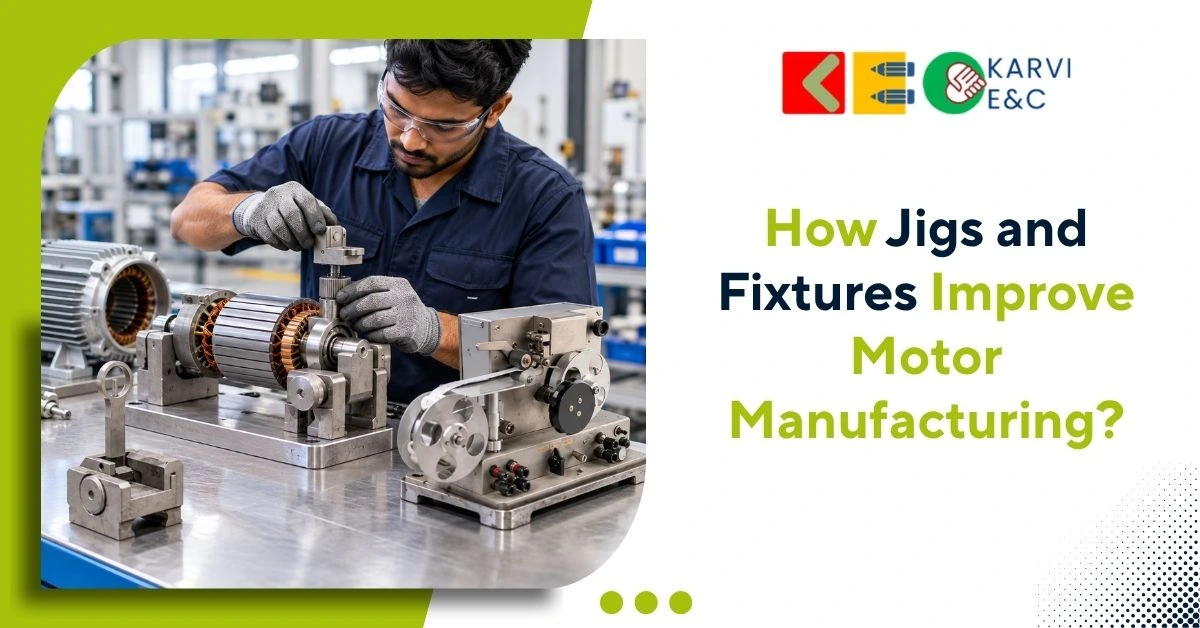
Motor manufacturing involves repetitive operations such as component positioning, brazing, assembly, and handling. When these tasks depend heavily on manual alignment, production can face inconsistent results, longer cycle times, and unnecessary rework. Jigs and Fixtures help address these challenges by controlling how components are positioned, held, and processed during different manufacturing stages.
1. Maintaining Component Alignment During Assembly
Motor assembly often requires components to remain in precise positions while operators fit or join them. Without suitable locating and holding arrangements, workers may need to adjust component positions repeatedly before completing an operation.
Custom fixtures hold components securely in the required position, reducing repeated alignment and supporting consistent assembly. In the Motor Industry, this is particularly useful for repetitive production tasks where the same positioning requirements must be maintained across multiple units.
2. Improving Accuracy in Motor Brazing
Brazing requires the relevant components to remain correctly positioned throughout the joining operation. In the Motor Industry, unstable positioning can affect consistency and lead to additional inspection or corrective work.
Dedicated motor brazing fixtures provide a stable arrangement for holding components during the process. By reducing unwanted movement and maintaining the required positioning, these fixtures help operators perform repeated brazing operations more consistently.
3. Reducing Setup Time in Repetitive Production
When operators repeatedly measure, position, and clamp components manually, preparation can consume a significant part of the production cycle. Variations in these steps may also affect consistency between units.
Purpose-designed Jigs and Fixtures provide predefined locating or holding arrangements, making repeated setups easier to perform. This can reduce manual adjustments and allow operators to move through established production sequences with fewer interruptions.
Looking to improve motor assembly accuracy and production consistency? Contact Us to discuss customized tooling and engineering solutions.
4. Supporting the Assembly of Heavy Motor Components
Large motor components can be challenging to lift, position, and assemble safely. Uncontrolled movement or difficult positioning can interrupt assembly and increase manual handling demands.
Fixtures designed for specific operations can help maintain component stability, while suitable heavy assembly handling machines assist with lifting and positioning. These Motor Assembly Fixtures and handling solutions support controlled assembly operations, reduce manual handling difficulties, and improve shop-floor workflow.
5. Improving Repeatability and Reducing Rework
Inconsistent positioning across production cycles can lead to dimensional variations, repeated adjustments, and additional quality checks. These issues can affect both manufacturing efficiency and final product consistency.
Well-designed tooling establishes repeatable conditions for specific operations. For manufacturers in the Motor Industry, this helps reduce variation caused by manual positioning and supports more consistent production outcomes. Fixture design should account for component geometry, required tolerances, accessibility, and the intended manufacturing process.
Choosing the Right Tooling for Motor Manufacturing
The effectiveness of a fixture depends on how well it matches the operation. Manufacturers should assess the component being handled, the accuracy required, the frequency of the task, and the operator’s access to the work area. Selecting suitable Motor Assembly Fixtures and custom-engineered solutions helps address specific production requirements while improving positioning accuracy and workflow consistency.
Frequently Asked Questions
They help locate, guide, or hold components during manufacturing operations, reducing repeated manual adjustments and supporting consistent assembly.
Motor brazing fixtures hold components in the required position during joining, helping minimize movement and improve repeatability between operations.
Fixtures provide predefined locating and holding arrangements, reducing the time operators spend measuring, aligning, and securing components for repetitive tasks.
They can help reduce positioning-related errors and process variation. Overall product quality also depends on component specifications, process parameters, operator practices, and inspection.
Important factors include component geometry, required tolerances, clamping method, production volume, operator accessibility, safety, and compatibility with existing equipment.
Conclusion
Jigs and fixtures improve motor manufacturing by controlling component positioning, simplifying brazing and assembly, and making repetitive setups more consistent. In the Motor Industry, well-designed Jigs and Fixtures can reduce manual adjustments, limit avoidable rework, and support smoother workflows. Combining precision tooling with suitable handling equipment helps manufacturers achieve more consistent assembly and improve overall production efficiency.
Fixture DesignJigs and Fixtures DesignJigs and Fixtures ManufacturingManufacturing FixturesMotor Manufacturing
Related Posts

Choosing an automation partner is an important decision for manufacturers planning to improve productivity, quality,…
Lean manufacturing is about removing activities that do not add value. Excess movement, waiting, manual…