100, Mohangirikrupa estate, Deluxe Wafer Lane, Nr Jupiter Cross Road, GIDC Makarpura, Vadodara



Developing a new product or industrial system involves design iterations, physical testing, material selection, and…
- Engineering Guides
- 5 minute read
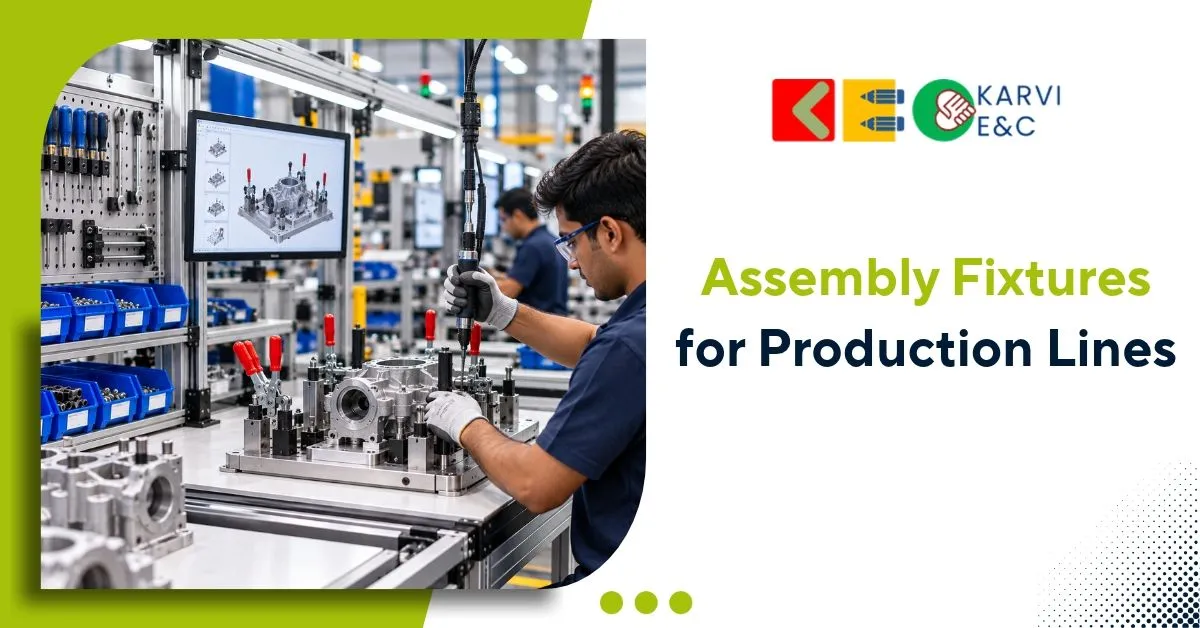
Manufacturing efficiency depends on how accurately and consistently components are positioned during assembly. Poor alignment, unstable workholding, and repeated manual adjustments can increase cycle times, create quality issues, and lead to unnecessary rework. Assembly Fixtures help address these challenges by holding components in the correct position, supporting repeatable assembly operations, and improving process control across production lines.
What Are Assembly Fixtures?
Assembly fixtures are specialized workholding devices designed to position and secure components during manufacturing and assembly. They help operators maintain the required alignment while performing tasks such as fastening, joining, fitting, and component installation.
Depending on the application, Assembly Fixtures can include locating pins, clamping mechanisms, support blocks, adjustable stops, and dedicated mounting arrangements. Their design depends on component geometry, assembly sequence, dimensional tolerances, and production volume.
How Assembly Fixtures Improve Production Efficiency?
Repeatedly positioning components by hand can consume valuable production time and introduce inconsistencies. Properly designed Assembly Fixtures provide defined locating points and stable support, reducing the need for repeated adjustments between assembly cycles.
Key benefits include:
- Faster assembly: Components can be positioned and secured more quickly.
- Consistent quality: Repeatable positioning helps maintain dimensional accuracy.
- Reduced rework: Stable workholding minimizes errors caused by component movement or misalignment.
- Improved operator efficiency: Clear locating and clamping arrangements simplify repetitive tasks.
- Better production flow: Consistent assembly operations help reduce delays between workstations.
These improvements are particularly useful in repetitive manufacturing environments where component positioning directly affects quality and cycle time.
Looking to improve assembly accuracy and production flow? Contact us to discuss custom fixture solutions.
Types of Assembly Fixtures Used in Manufacturing
Different production processes require different workholding arrangements. Selecting the right fixture depends on the assembly task, component design, and required level of repeatability. Assembly Fixtures can be designed for manual operations, powered clamping, flexible production requirements, or integration with automated manufacturing systems.
Manual Assembly Fixtures
Manual fixtures use mechanical locating and clamping arrangements to support operator-led assembly. They are suitable for production processes where flexibility and straightforward operation are important. Properly designed Assembly Fixtures help operators position components accurately and reduce repeated manual adjustments.
Pneumatic and Hydraulic Fixtures
These fixtures use powered clamping mechanisms to secure components. They can reduce manual clamping effort and provide consistent holding force when designed for the application.
Modular Assembly Fixtures
Modular systems use interchangeable components to accommodate different parts or product variants. They can be useful when production requirements change frequently or several similar components share common locating features. Modular Assembly Fixtures provide flexibility while helping manufacturers maintain positioning accuracy during product changeovers.
Automated Fixture Integration
Fixtures can also be integrated with special purpose machines, sensors, and automated assembly systems. This allows component positioning and workholding to become part of a controlled production sequence. Integrated Assembly Fixtures can support repeatable operations, reduce manual intervention, and improve coordination between assembly and inspection processes.
Important Factors in Fixture Design
A fixture must suit the component and the production process rather than simply hold the part in place. Several engineering considerations influence the performance of Assembly Fixtures and their ability to maintain consistent production quality.
- Positioning accuracy: Locating elements must position components within the required tolerances.
- Clamping force: Components must remain secure without being distorted or damaged.
- Accessibility: Operators and tools need sufficient access to complete the assembly operation.
- Durability: Materials and construction should withstand repeated production cycles.
- Ergonomics and safety: Loading, unloading, and clamping should be practical and safe.
- Changeover requirements: Interchangeable or adjustable elements may be necessary for multiple product variants.
Careful fixture design helps maintain process stability while supporting efficient day-to-day production.
Integrating Assembly Fixtures with Production Automation
Fixtures can provide a foundation for more advanced manufacturing systems. When integrated with special purpose machines, assembly stations, sensors, and inspection equipment, Assembly Fixtures help maintain consistent component positioning throughout automated or semi-automated operations.
Karvi Engineering & Consultancy develops custom jigs and fixtures for machining, welding, assembly, and inspection applications. Its engineering approach includes fixture design, CAD modeling, tolerance stack-up analysis, engineering validation, and automated fixture integration to address specific manufacturing requirements.
Frequently Asked Questions
Assembly fixtures position and secure components during assembly, helping maintain alignment, repeatability, and process consistency while reducing unnecessary manual adjustments.
They provide stable workholding and defined locating points, helping reduce positioning errors and component movement that can cause defects or inconsistent assembly.
Yes, Fixtures can be designed around specific component geometry, assembly sequences, tolerances, clamping requirements, and production volumes.
Yes, Fixtures can be integrated with special purpose machines, sensors, and automated assembly systems to support controlled positioning and repeatable operations.
Important factors include positioning accuracy, clamping force, component accessibility, durability, operator safety, changeover requirements, and compatibility with the production process.
Conclusion
Consistent assembly requires accurate positioning, reliable workholding, and a repeatable process. By reducing manual adjustments, improving component alignment, and supporting stable assembly cycles, Assembly Fixtures can help manufacturers improve production efficiency and reduce quality-related costs. Choosing a fixture that matches the component, process, and production environment is essential for achieving dependable results.
Assembly Fixture DesignAssembly Line AutomationAssembly Line EquipmentAssembly Line FixturesIndustrial Fixtures
Related Posts
Plastic components have become an integral part of modern manufacturing, serving industries that demand precision,…
Modern manufacturing depends on precision, repeatability, and process consistency to produce high-quality products at scale…