100, Mohangirikrupa estate, Deluxe Wafer Lane, Nr Jupiter Cross Road, GIDC Makarpura, Vadodara


Industries today operate in an increasingly competitive environment where efficiency, speed, and adaptability determine long-term…
- Automation Tips
- 9 minute read
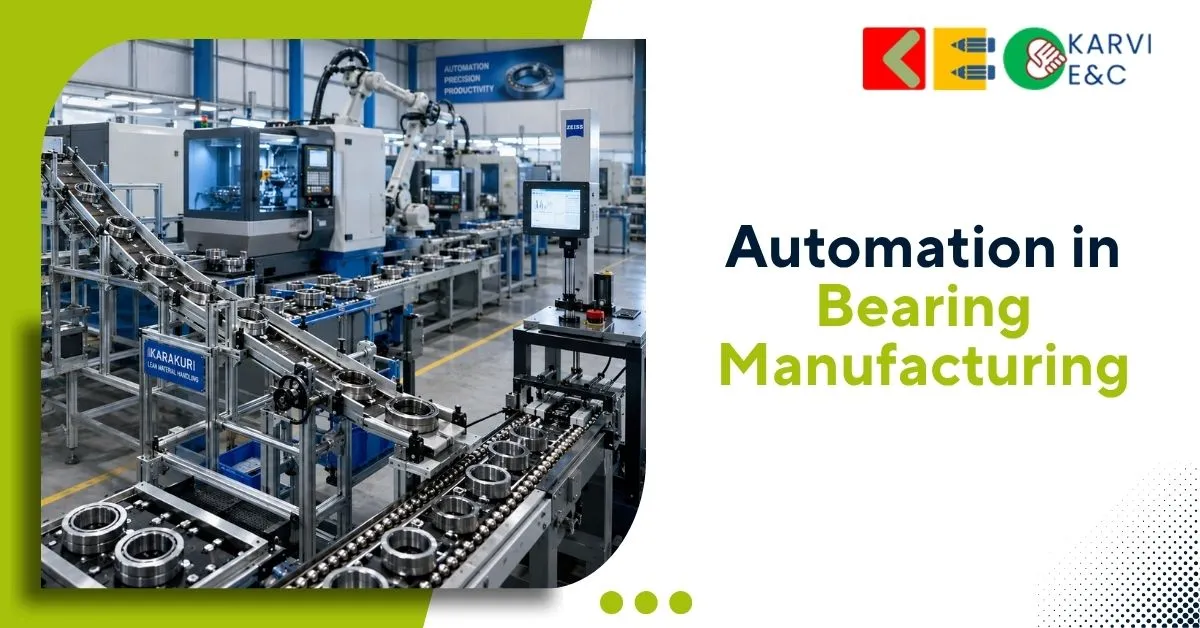
Bearing manufacturing requires precision, consistency, and controlled production processes to ensure reliable performance in demanding applications. From handling components to machining, grinding, inspection, and assembly, every stage must maintain accurate positioning and repeatable results. As production volumes increase, relying heavily on manual operations can create challenges related to cycle time, material movement, operator fatigue, and process consistency.
Automation provides manufacturers with practical ways to streamline these operations while improving productivity and workplace efficiency. In Bearing Manufacturing, solutions such as manual workstations, conveyor systems, machine loading and unloading, grinding support equipment, and Karakuri systems can help connect individual operations into a more efficient production flow. The objective is not simply to replace manual work, but to optimize repetitive activities, improve material movement, and create a more consistent manufacturing environment.
Why Automation Matters in Bearing Production?
Bearing production involves multiple interconnected operations where delays or inconsistencies at one stage can affect the overall production flow. Components need to move between processes efficiently, machines must be supplied consistently, and operators need suitable workstations for inspection, assembly, and other repetitive activities.
Automation helps address these challenges by creating more organized and predictable workflows. In Bearing Manufacturing, automated and semi-automated solutions can reduce unnecessary material handling, improve machine utilization, and support consistent production cycles. This allows operators to focus on activities that require greater attention while repetitive movement and handling tasks are optimized through suitable engineering solutions.
Improving Material Flow Across the Production Line
Efficient material movement is essential when components pass through several production stages. Manual transportation between machines or workstations can create unnecessary movement, waiting time, and production bottlenecks. Poorly organized material flow can also increase the risk of handling errors and workplace inefficiencies.
Industrial conveyor systems provide a structured method for transferring components between production areas. In Bearing Manufacturing, conveyors can be integrated into production lines to maintain a continuous flow of materials while reducing unnecessary manual transportation. Their configuration can be adapted to available plant space, production requirements, and the sequence of manufacturing operations.
A well-planned material handling system can help manufacturers achieve:
- Smoother movement between production stages
- Reduced manual transportation
- Better workstation coordination
- Lower handling time
- Improved production flow
- More organized shop-floor operations
Optimizing Machine Loading and Unloading
Machine utilization is an important factor in maintaining efficient production. When operators spend significant time manually loading and unloading components, machine availability can be affected and cycle times may increase. Repetitive loading activities can also contribute to operator fatigue when performed continuously.
Loading and unloading automation helps create a more consistent interface between machines and production personnel. In Bearing Manufacturing, these systems can support repetitive component handling while maintaining accurate and timely machine feeding. Depending on production requirements, the solution can be designed around specific machines, component characteristics, and cycle times.
Improving these activities can help manufacturers reduce idle machine time and maintain a more consistent production rhythm. It also provides opportunities to redesign repetitive work around safer and more ergonomic operating conditions.
Designing Efficient Workstations for Operators
Not every manufacturing activity needs to be fully automated. Certain processes, particularly assembly, inspection, and testing, may continue to require skilled operator involvement. In such cases, the design of the workstation becomes an important part of overall productivity.
Ergonomically designed workstations can organize tools, components, fixtures, and operating areas according to the sequence of work. In Bearing Manufacturing, modular workstations can support assembly, inspection, and testing activities while reducing unnecessary operator movement.
A properly designed workstation can improve accessibility, reduce repetitive strain, maintain organized material presentation, and support consistent working methods. Combining operator-focused workstation design with automation in surrounding processes can create a balanced production system rather than relying on complete automation for every operation.
Supporting Precision Through Grinding and Process Equipment
Grinding operations are important in applications where component accuracy and surface finish directly influence final bearing performance. These operations require controlled processes and reliable handling to maintain consistency throughout production.
Specialized grinding tools and support equipment can help improve the accuracy and efficiency of these operations. In Bearing Manufacturing, such solutions can be integrated with material handling and production systems to create a more coordinated workflow around precision processes.
The objective is to ensure that components reach the required operation in a consistent manner while minimizing unnecessary handling. When grinding support equipment is combined with suitable process automation, manufacturers can improve workflow efficiency without compromising the precision requirements of the production process.
Using Karakuri for Lean Manufacturing
Automation does not always require complex electrical systems or high levels of robotics. Simple mechanical solutions can sometimes provide an effective way to improve material movement and reduce unnecessary effort.
Karakuri systems use principles such as gravity, springs, and counterweights to move or present materials with minimal or no external energy. In Bearing Manufacturing, these systems can be used for material presentation, movement between work areas, or other repetitive handling applications where a simple mechanical solution is sufficient.
Karakuri can support lean manufacturing objectives by reducing unnecessary motion, simplifying material flow, and minimizing energy consumption. Its relatively simple construction can also make certain solutions easier to maintain compared with more complex automated systems.
Improving Productivity Through Connected Operations
Productivity is not determined by the speed of a single machine. Overall performance depends on how effectively machines, operators, workstations, material handling systems, and supporting processes work together.
Automation can connect these activities into a more coordinated production environment. In Bearing Manufacturing, combining conveyors, loading and unloading systems, workstations, grinding support, and other productivity solutions can reduce gaps between operations and create a smoother workflow.
This approach helps manufacturers identify where manual handling, waiting time, repeated movement, or inconsistent processes are limiting production performance. Instead of automating isolated tasks without considering the wider process, an integrated approach focuses on improving the complete production flow.
Looking to improve your bearing production flow with practical automation solutions? Contact Us to optimize material handling, machine operations, and productivity.
Reducing Manual Handling and Repetitive Operations
Repeated handling activities can consume valuable production time while placing additional physical demands on operators. Tasks such as transferring components, loading machines, unloading finished parts, or repeatedly reaching for materials can often be optimized through suitable engineering solutions.
In Bearing Manufacturing, automation can reduce unnecessary manual intervention in repetitive operations while allowing employees to focus on inspection, decision-making, and other higher-value activities. This does not necessarily mean removing operators from the process. Instead, it creates opportunities to redesign work so that people and machines perform the activities they are best suited for.
Reducing unnecessary manual handling can also contribute to improved workplace organization, more consistent cycle times, and better utilization of production resources.
Building a More Efficient Bearing Manufacturing Facility
Creating an efficient production facility requires more than installing individual automation systems. Each solution should be selected according to production volume, component characteristics, available space, machine requirements, operator involvement, and desired productivity improvements.
A manufacturing facility may combine conveyor systems for material movement, loading and unloading automation for machine utilization, ergonomic workstations for operator activities, grinding tools for precision processes, and Karakuri systems for simple material handling. In Bearing Manufacturing, these solutions can work together to create a production environment that is more organized, consistent, and adaptable.
The most effective approach begins by studying the existing workflow, identifying bottlenecks and repetitive activities, and then developing practical solutions around specific production requirements. This ensures that automation investments address actual operational challenges rather than introducing unnecessary complexity.
Choosing the Right Automation Approach
Every bearing production facility has different requirements, so there is no single automation solution that fits every operation. Production volume, component size, machine configuration, cycle time, workforce requirements, and available floor space all influence the right approach.
Manufacturers should evaluate where automation can deliver the greatest operational value. In some cases, a conveyor or ergonomic workstation may provide the required improvement, while other applications may benefit from machine loading and unloading automation or specialized productivity solutions.
The goal should be to achieve measurable improvements in production flow, machine utilization, handling efficiency, consistency, and operator productivity. A practical engineering approach ensures that each automation solution fits naturally into the existing manufacturing environment and can support future production requirements.
Building Smarter and More Productive Operations
The future of bearing production will increasingly depend on the ability to combine precision manufacturing with efficient material handling and intelligent process optimization. Manufacturers that systematically address repetitive operations, production bottlenecks, and inefficient workflows can create stronger foundations for long-term productivity.
Automation provides the flexibility to improve individual operations while also supporting broader lean manufacturing objectives. In Bearing Manufacturing, the combination of engineered workstations, conveyors, loading and unloading solutions, grinding support, Karakuri systems, and specialized productivity solutions can help manufacturers move toward more efficient and future-ready production environments.
Frequently Asked Questions
Automation helps improve material movement, machine utilization, repetitive handling, and production consistency. It allows manufacturers to optimize workflows while reducing unnecessary manual operations.
Conveyors provide organized material movement between production stages, reducing manual transportation, handling time, and interruptions in the overall production flow.
Yes. Machine loading and unloading systems can automate repetitive component handling, improve machine utilization, and maintain more consistent production cycles.
Karakuri systems use mechanical principles such as gravity, springs, and counterweights to move or present materials without relying heavily on electrical energy.
Not necessarily. Automation can reduce repetitive tasks while allowing operators to focus on assembly, inspection, testing, monitoring, and activities requiring human judgment.
Conclusion
Efficient bearing production depends on consistent processes, reliable material movement, accurate operations, and effective use of production resources. Automation can address these requirements by optimizing repetitive handling, improving machine utilization, supporting precision processes, and creating smoother workflows.
From conveyor systems and machine loading solutions to ergonomic workstations, grinding support, and Karakuri systems, manufacturers can select solutions according to their specific operational challenges. By taking an integrated approach to Bearing Manufacturing, businesses can improve productivity, reduce unnecessary manual handling, strengthen process consistency, and build more efficient production environments prepared for future manufacturing demands.
Ball Bearing ManufacturingBearing Ball ManufacturingBearing Manufacturing IndustryBearing Manufacturing ProcessManufacturing of Bearing
Related Posts
The automotive industry has long been recognized as one of the earliest adopters of advanced…
The manufacturing and industrial sectors are rapidly evolving with the adoption of advanced technologies that…